Read a Museum Fashion Credit Before Turning an Archive Image into a Designer Story
An archive image can be a rich source of design observation, but its caption contains different kinds of attribution. A maker, designer, donor and collection credit are not interchangeable roles. Read the full record before attaching a historical garment to a present-day shopping narrative or repeating a story from a cropped image.
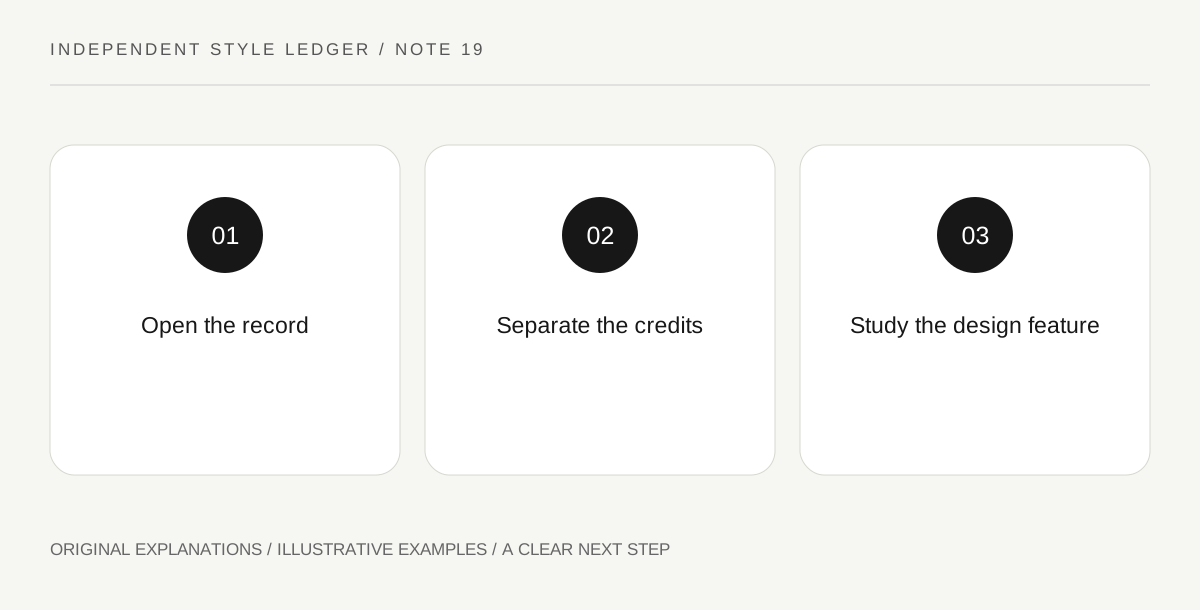
Original explanatory diagram. Read the full method and limitations below.
Open the object record rather than the repost
The Met’s Callot Soeurs evening-dress record provides a bounded example of an object page with design attribution and a credit line. Read those fields as separate information. A social-media crop may omit the date, material or qualification around an attribution. Record the institution and stable object page with your notes so you can return to the evidence instead of relying on a caption copied through several unrelated accounts.
Keep the named roles distinct
Identify the fashion house or maker, any individually named designer and the person or institution credited with giving the object. A donor credit does not mean the donor designed or wore the garment. If the record does not establish the original wearer, do not invent one from a familiar surname. Keep uncertainty and qualified wording intact rather than improving the story into a confident anecdote.
Observe design features independently of ownership history
Study the visible arrangement of shape, decoration and material, using the museum’s description where relevant. You can learn from a neckline or panel arrangement without proving a glamorous biography for the object. Write observations as observations, especially when the image does not show the back or interior. Avoid describing a conserved collection piece as evidence of how a newly manufactured retail garment will perform in everyday use.
Keep archive study separate from current availability
A museum record is not a current product listing or an endorsement of a modern seller using a similar image. If a contemporary studio refers to an archive influence, read its own explanation and actual product specifications. Do not imply that a historical designer or museum approved the new item. The archive can inform a feature brief while the purchasing decision remains attached to the contemporary object’s documented identity.
Illustrative worked example
Illustrative example: A reader sees a fictional repost naming only a famous house and a donor. On opening the museum record, the reader distinguishes the house, individual design attribution and gift credit, then notes a curved panel arrangement that interests them. That design observation becomes an independent study note. It does not become a claim that the donor created the dress or that a current retail item is an authorized archive reproduction.
Questions that come up
Does a credit line identify the original wearer?
Not necessarily. It may describe how an institution acquired an object. Use only the role established by the record, and leave the wearer unknown when the documentation does not support an identification.
Can I use archive study to clarify my preferences?
Yes. Describe a visible shape or construction idea and keep its source in your notes. That does not establish endorsement, authenticity or equivalence for a contemporary garment offered by another seller.
References and scope
These sources support the factual background. Examples and exercises are original illustrative teaching material. References do not imply endorsement.
- The Met: Callot Soeurs evening dress — A collection record distinguishes design attribution, date, materials and credit line; not a current shopping listing.