Use a Lookbook for Design Ideas and Product Views for Garment Questions
A lookbook can communicate a collection’s mood beautifully while leaving ordinary garment questions unanswered. Treat its images as one kind of evidence. Record the design feature that interests you, then use contextual product views and written specifications to understand the actual piece before comparing an accessible alternative.
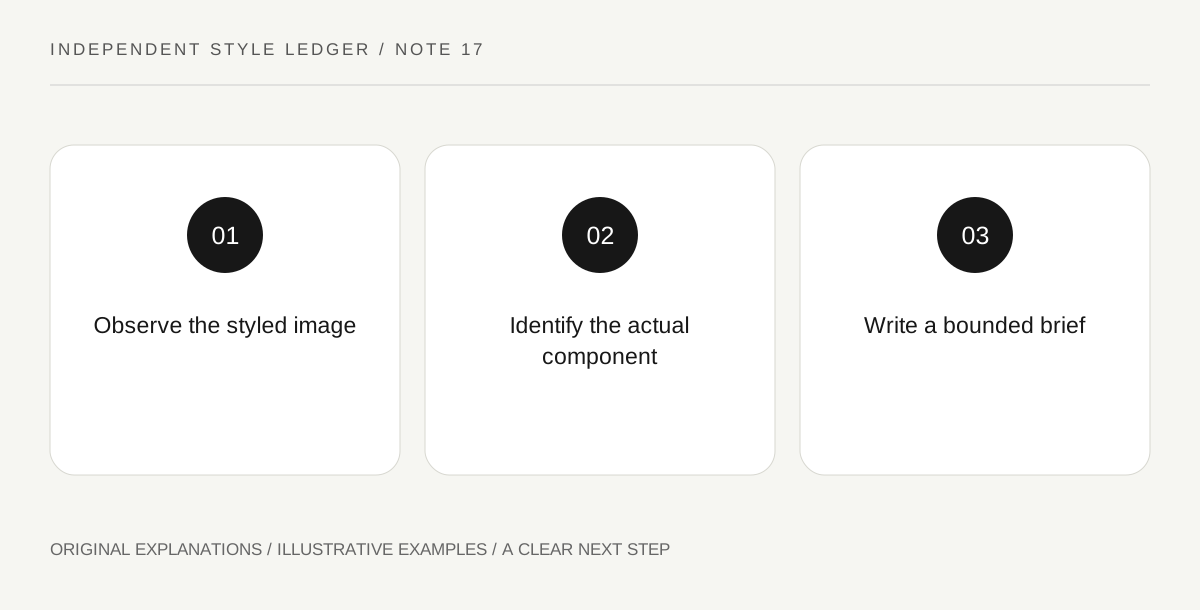
Original explanatory diagram. Read the full method and limitations below.
Describe the image before naming a trend
Write down visible features: a broad sleeve outline, a long uninterrupted front or a repeated curved edge. Separate those observations from the location, lighting and other garments in the image. A dramatic setting can shape your impression without being part of the item you would own. You do not need to know the photographer’s unseen methods to recognize that a picture is a composed presentation.
Ask which garment creates the effect
Identify whether the feature belongs to the item sold or to another layer in the outfit. A visible neckline, belt or collar may come from a separate piece. Check the product description and any item list attached to the image. Do not assume every object shown is included. If a desirable detail disappears in the standalone product view, investigate which component actually supplied it before adding the item to a shortlist.
Find views that answer functional questions
Look for the back, fastening, interior and a clear depiction of the garment without obstructing layers where relevant. V&A work on hidden fashion construction illustrates why appearance cannot reveal every layer. Ordinary retail views also have limits. Ask for a specific missing detail rather than treating an atmospheric photograph as evidence of pocket capacity, lining layout or the way the item will move on your own body.
Translate the idea into your own requirements
You may want the broad silhouette without the collection’s complete outfit. List the one or two design relationships worth preserving, then examine your existing clothes and legitimate alternatives for those features. Keep material and construction differences visible. This turns inspiration into a bounded design brief rather than a demand to reproduce a photograph exactly, including lighting, pose and objects that cannot come with the purchase.
Illustrative worked example
Illustrative example: A reader saves a fictional lookbook image for its tall folded neckline. In the standalone product photograph, the jacket has an ordinary open collar; the high fold comes from a separate scarf. The reader updates the brief to a scarf-and-jacket relationship and checks existing pieces before shopping. The discovery concerns what the image actually contains, not a claim that the maker manipulated or misrepresented the garment.
Questions that come up
Is an atmospheric photograph useless for shopping?
No. It can help you identify design preferences and collection ideas. Its value increases when you use it for those questions and obtain other evidence for fit, composition and functional details.
Must an alternative recreate the entire styled image?
No. Identify a limited feature or relationship you want to explore. You can adapt that idea using existing clothes or a different original design while clearly accepting the differences in material, shape and context.
References and scope
These sources support the factual background. Examples and exercises are original illustrative teaching material. References do not imply endorsement.
- V&A: X-raying fashion — Museum examination reveals hidden garment construction; normal retail pictures cannot substitute for that investigation.