Made to Order: Clarify Production Timing and Fit Customization Separately
A garment made after an order is placed may still use standard sizes and a fixed design. Before planning an independent-label purchase, separate when production begins from what the maker will customize. A long lead time does not by itself establish a personal fitting service or a specially drafted pattern.
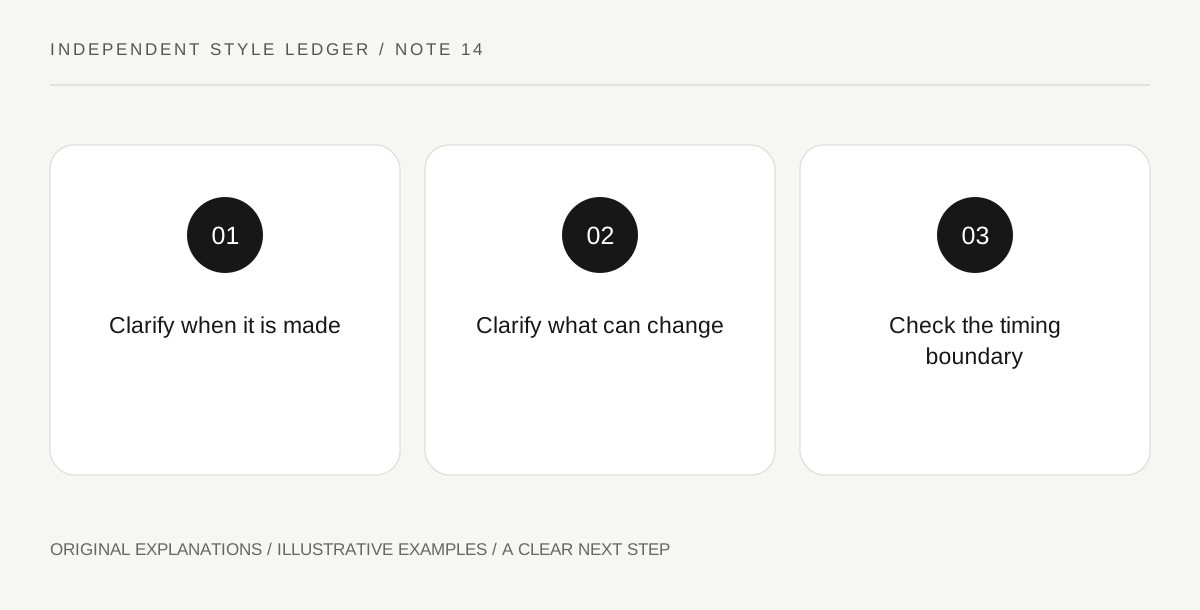
Original explanatory diagram. Read the full method and limitations below.
Read the actual production description
TOAST uses made to order for a collection description, illustrating that the phrase can describe a production approach. For the item you are considering, ask what happens after ordering: material allocation, production scheduling or another defined step. Keep that answer tied to the product and seller. Do not infer a universal service package from the phrase or assume a label used by one studio has identical terms elsewhere.
List the fit decisions the buyer can make
Write down whether you choose a standard size, supply measurements, select a length or attend fittings. Include only options the maker actually offers. A colour choice is not a fit adjustment, and a measurement request does not reveal how a pattern will be created. Ask about the process if that distinction matters to you, without using bespoke as a flattering substitute for information that has not been provided.
Separate production, dispatch and arrival
Ask how the quoted lead time is defined and whether it is an estimate or a specific commitment. Keep production completion, dispatch and arrival as separate events in your plan. If the garment is for an important occasion, allow for the uncertainty and have a practical alternative. Avoid promising yourself a delivery date by adding a generic transit estimate to an unclear production statement.
Confirm the decision points before ordering
Read when choices become fixed, what changes can be requested and the applicable cancellation or return terms. These depend on the actual seller, order and jurisdiction; do not assume all made-to-order items have the same legal treatment. Save the specific agreed details. A lower price or appealing production story should not rush you past an unresolved size choice or an essential deadline.
Illustrative worked example
Illustrative example: Kim considers a fictional made-to-order jacket for an event. The studio confirms that it produces standard sizes after purchase and offers no individual pattern changes. Its lead time refers to dispatch, not arrival. Kim records those details and chooses an existing suitable outfit for the event while evaluating the jacket as a separate future purchase. The example does not claim a universal cancellation rule or a delivery guarantee.
Questions that come up
Does made to order mean made to my measurements?
Not necessarily. Ask which measurements or fitting decisions the maker uses and what can actually be changed. The production timing label alone does not establish individualized sizing.
Can I rely on a generic delivery estimate?
Use the specific seller’s current explanation and distinguish production from transit. For a fixed occasion, plan around the uncertainty instead of treating a broad estimated range as a guaranteed arrival promise.
References and scope
These sources support the factual background. Examples and exercises are original illustrative teaching material. References do not imply endorsement.
- TOAST: made to order — A maker uses made-to-order as a collection description; buyers still need specific fit, production and order terms.
- FTC: online shopping — Checking total cost and specific order details; article avoids jurisdiction-specific deadlines or individualized legal advice.