A Named Atelier Adds a Production Lead, Not a Complete Garment Biography
An independent label may name the workshop that made a garment, giving you a more specific production story than a country alone. Read that information carefully. Identify the operation and source of the claim, then distinguish the named making stage from other stages that the hangtag does not document.
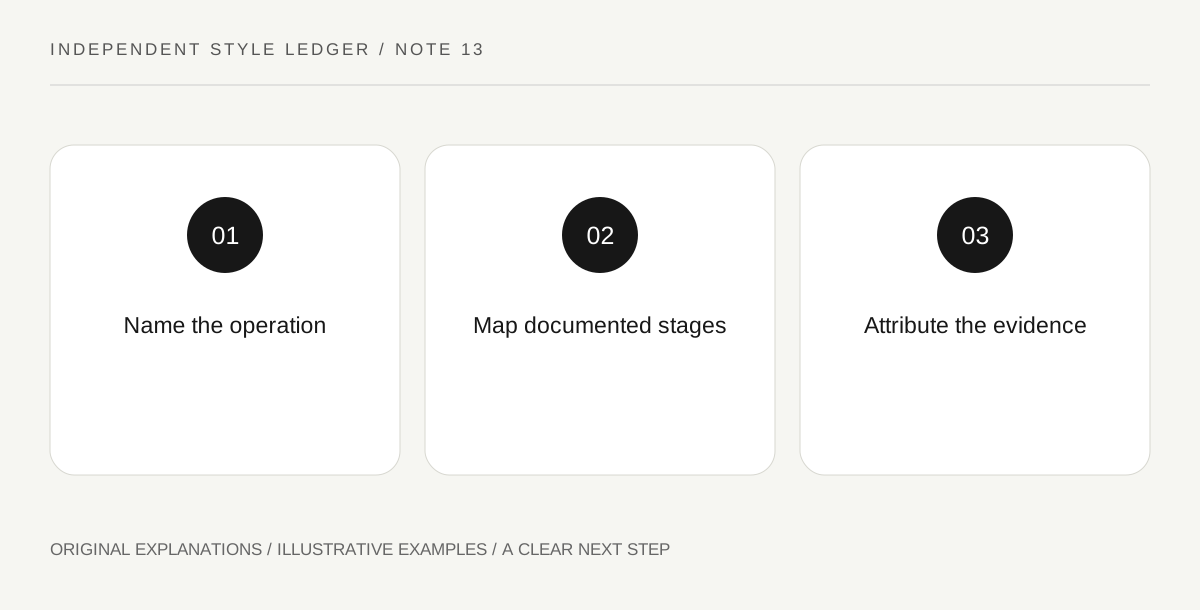
Original explanatory diagram. Read the full method and limitations below.
Start with the maker’s exact statement
De Bonne Facture describes a hangtag approach naming an atelier, its locality and history. That is a useful example of a brand explaining its production documentation. Attribute it as the brand’s stated approach, rather than claiming an independent audit of every item. When examining another garment, record what its own documentation actually names instead of transferring the example label’s practice to an unrelated studio.
Separate design, fabric and garment making
A named workshop may carry out a particular stage, while fabric production and design attribution involve other parties. Draw a simple chain with separate boxes for the information provided. Leave undocumented stages blank. A location for garment assembly should not silently become the origin of every fibre, dye, fastening or design decision. The blank spaces are limits of the current evidence, not proof of wrongdoing.
Ask a question that can be answered
If production history matters to you, ask about one missing stage or operation. For example, does the named atelier cut and assemble the garment, or perform a specialist finish? A focused question is more useful than asking whether everything is ethical, a phrase too broad to establish from a short reply. Respect information the business cannot verify and avoid expanding a partial answer into a comprehensive certification.
Connect the story to the purchase decision
You may value knowing who performed a particular making stage, but keep that preference alongside fit, materials, care and spending limits. A workshop name does not guarantee personal comfort or establish a resale value. Preserve the original tag or product information with the garment if it matters to your ownership record. The story becomes useful when it remains specific and accurately attributed through time.
Illustrative worked example
Illustrative example: A fictional coat page names the studio responsible for assembly and separately names the fabric mill. A reader places those two claims in different boxes and asks who performs the final finishing step. The reply leaves fibre sourcing unspecified, so that box remains blank. The reader can appreciate the documented stages without writing a claim that every component came from the same place or that the whole supply chain has been independently certified.
Questions that come up
Does an atelier name prove every component has the same origin?
No. It identifies only the stage and scope actually documented. Read separate material and origin statements rather than extending one workshop’s location to the whole production chain.
Is a detailed brand story the same as independent verification?
No. It is a source that can be specific and useful, but its authorship matters. Attribute the statement and distinguish it from an external assessment with its own published method and scope.
References and scope
These sources support the factual background. Examples and exercises are original illustrative teaching material. References do not imply endorsement.
- De Bonne Facture: production approach — The brand describes naming an atelier, locality and history on its hangtags; a self-description, not independent verification of every claim.