Map a Bag’s Materials by Panel Instead of Calling the Whole Thing Leather
A bag may combine a main body, handles, trim and lining made from different materials. One material word in a headline cannot describe every component. Draw a simple panel map before comparing a designer piece with a lower-priced alternative, and keep the description attached to the part it actually identifies.
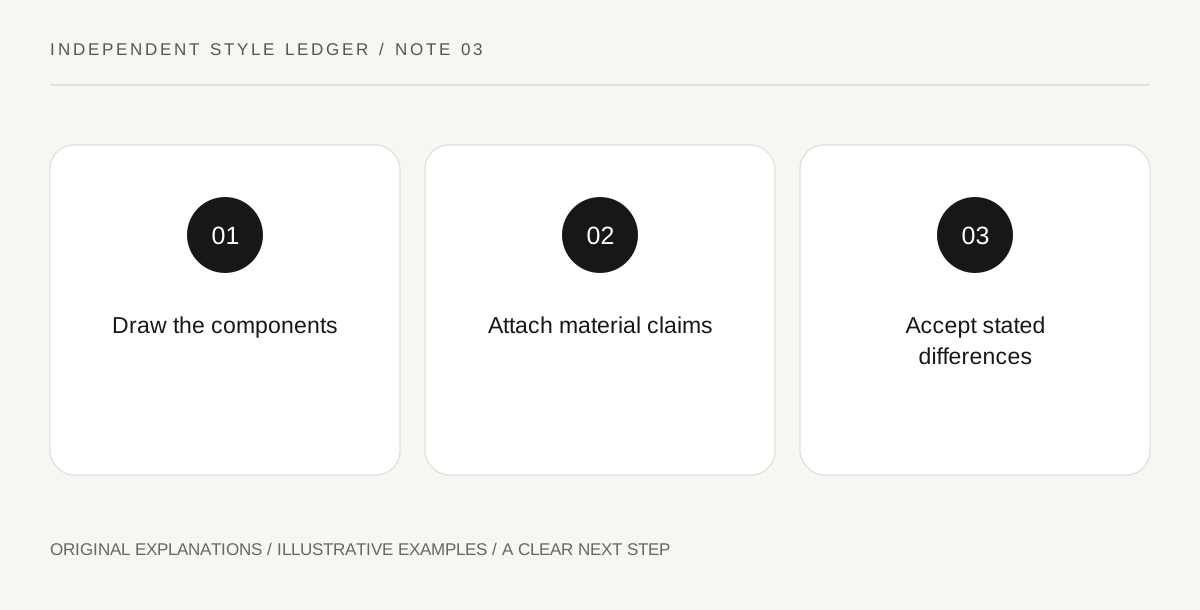
Original explanatory diagram. Read the full method and limitations below.
Divide the object into named components
List the exterior body, base, handles or strap, edge trim, lining and hardware. Use the seller’s own terminology where it is clear. Then place each stated material beside its component. A leather trim description should not silently become an all-leather bag claim. If the page only says material without identifying which part it covers, ask a specific question about the missing component instead of assuming uniform construction.
Read imitation and composite terms literally
The FTC’s Leather Guides address accurate composition claims and disclosure where a covered material looks like leather but is not. Use that principle to seek clear wording, rather than treating every alternative material as interchangeable. Do not infer the full composition or expected lifespan from a broad lifestyle label. Ask what the material is and which part uses it, keeping unverified assumptions out of the comparison.
Connect composition to your intended handling
A bag carried briefly to an event and one used daily for documents have different practical jobs. Note the required opening, capacity and carrying arrangement without claiming that one material automatically solves them. Ask the maker how the particular finish should be cared for and what repairs are supported. Do not apply generic leather conditioner to an unknown panel or coating simply because the whole product was advertised with a leather-related word.
Describe an alternative without claiming equivalence
If a lower-priced bag repeats an outline you like but uses different materials, state both facts. Avoid phrases suggesting identical construction unless you have evidence for all relevant components. Keep logos and authenticity separate from the design comparison, and buy through a legitimate seller. The objective is an honestly described option that suits your use, not an unsupported claim that it reproduces every feature of another product.
Illustrative worked example
Illustrative example: A shopper draws a rectangle for the body, two handles and a lining compartment. The listing specifies leather handles and a different exterior material. That map prevents the shopper from comparing its entire price with a fully specified leather-body bag as though only the label changed. The lower-priced option remains a possible choice for its own design, with the component differences clearly accepted rather than hidden.
Questions that come up
Does a leather handle prove the rest is leather?
No. Keep the handle claim limited to the handle. Read the body, trim and lining descriptions separately and ask for missing information rather than extending one accurate statement to the whole object.
Can a non-leather option be suitable?
Yes. Suitability depends on the actual product, your intended use and the documented care and repair options. This article does not rank material categories by durability or environmental impact; those claims require additional specific evidence.
References and scope
These sources support the factual background. Examples and exercises are original illustrative teaching material. References do not imply endorsement.
- FTC: leather guides — Accurate composition and non-leather disclosure in covered products; no durability ranking.