Read the Percentage Behind a Cashmere Blend Headline
A small amount of a familiar luxury fibre can dominate a product headline. The full composition tells a more specific story. When comparing a cashmere blend with another knit, keep every named fibre and percentage visible, then evaluate the garment you would actually receive rather than the impression created by one prominent word.
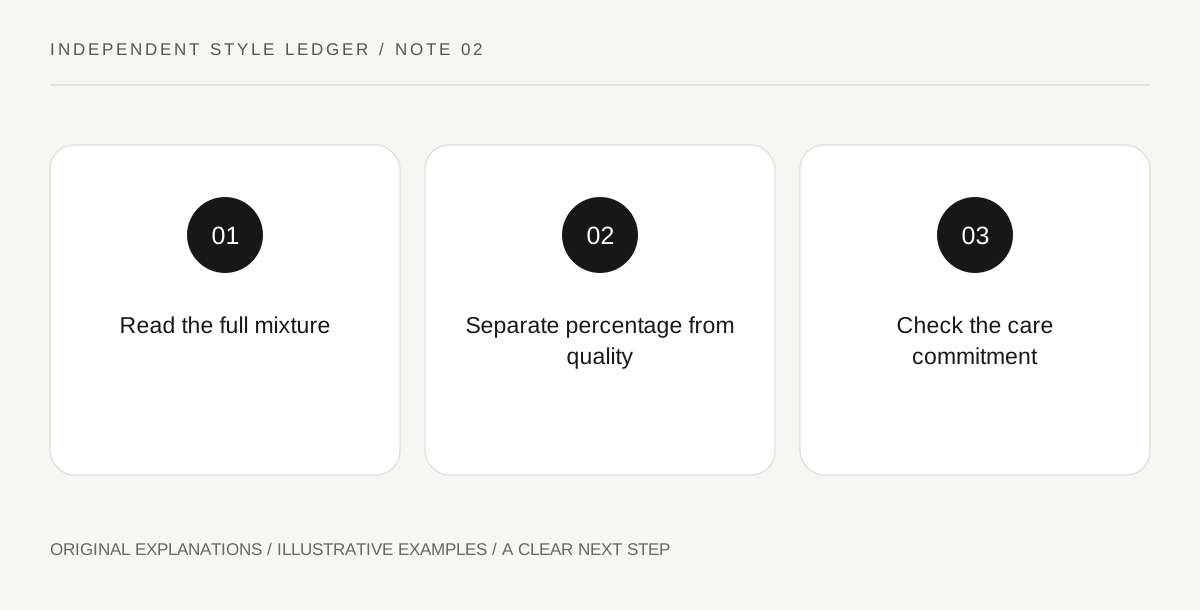
Original explanatory diagram. Read the full method and limitations below.
Transcribe the complete composition
The FTC’s cashmere guidance addresses accurate descriptions of wool and cashmere blends in the United States. For your comparison, write the entire composition rather than shortening it to cashmere jumper. Check that the product details and label information refer to the same variant. If one page omits the percentages, keep them unknown and request clarification instead of estimating from price, softness claims or a model photograph.
Avoid turning percentage into a quality score
A composition percentage identifies the stated mixture; it does not describe every aspect of yarn, knit structure, finishing or garment construction. Two items sharing a fibre percentage can still differ in shape and handling. Likewise, a blend can be a deliberate design choice rather than an inferior copy. Decide which properties matter to you and look for evidence about those, without inventing a durability ranking from the ingredient list alone.
Treat pashmina wording as a prompt for clarification
The FTC explains that pashmina is not a separate fibre category in its guidance. When the term appears prominently, read the underlying composition and ask how the seller is using it. Do not infer a rare new material or a guaranteed origin from the word. Keep the regional and regulatory context clear; this reading exercise does not establish the legal status of an individual listing in every country.
Compare the maintenance commitment
Read the supplied care guidance for each completed garment and consider the space, time and service access it requires. A low initial price is not the only practical difference if one piece needs a routine you will not follow. Keep care information attached to the exact item rather than borrowing advice from another knit. If you already own a similar garment, its documented routine can help you frame questions without proving the new one will behave identically.
Illustrative worked example
Illustrative example: An invented shortlist contains a knit described as a cashmere blend and another described as wool. On reading the full details, Sam discovers that the first has three listed fibres and a different care instruction. Sam records both compositions without scoring them by a single percentage, then compares the intended shape and manageable maintenance. The exercise does not assert that either fictional knit is warmer, softer or more durable.
Questions that come up
Does a higher cashmere percentage guarantee a better purchase?
No. Percentage alone does not establish fit, construction, personal comfort or the practicality of care. Use it to understand the material claim while assessing the remaining garment details on their own evidence.
Can I verify fibre content by touch?
Touch can inform personal preference, but it is not a reliable home certification method. Do not claim to authenticate a fibre from a brief handling impression; seek accurate labeling and appropriate professional assessment when needed.
References and scope
These sources support the factual background. Examples and exercises are original illustrative teaching material. References do not imply endorsement.
- FTC: cashmere labeling — Cashmere blends need accurate fibre descriptions; pashmina is not a separate FTC fibre category.
- FTC: care labeling — Care instructions concern the finished covered garment; alternative methods should not be inferred from fibre alone.