Ask Which Operation Is Hand Finished Instead of Treating the Whole Garment as One Claim
Hand finished can describe a specific operation on a garment made through several processes. Read the phrase at that level. Identifying the work involved helps you appreciate a detail, compare an alternative and avoid turning a small accurate claim into an invented story about every stage of production.
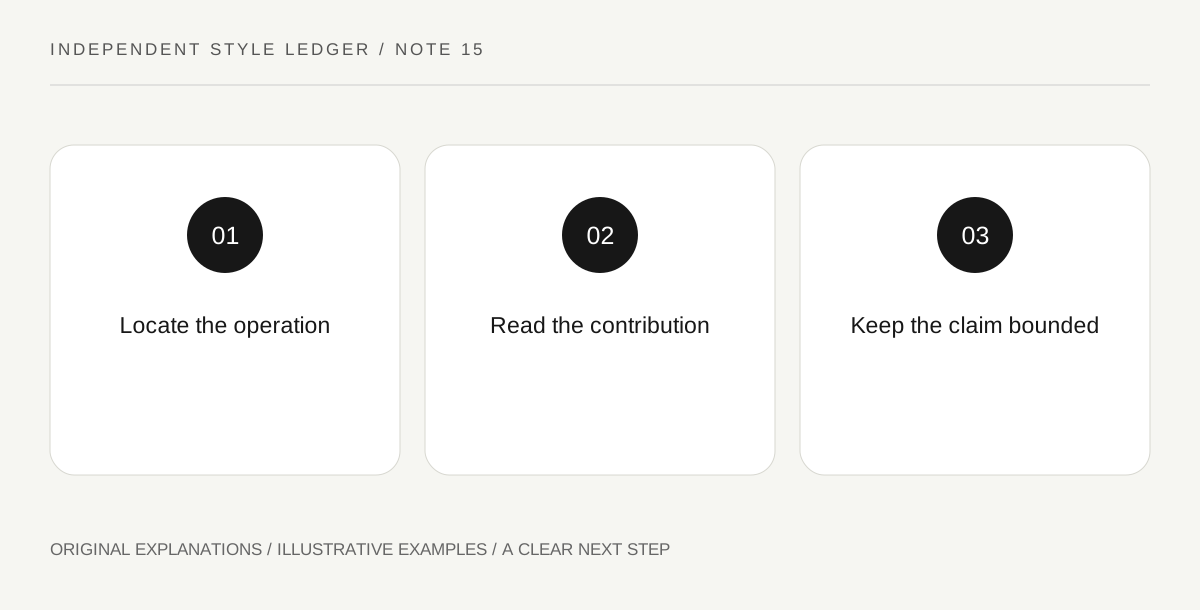
Original explanatory diagram. Read the full method and limitations below.
Locate the named work
Look for an explanation of whether the phrase refers to embroidery, a hem, a fastening, edge work or another operation. V&A embroidery resources show how many distinct techniques can sit within one craft category. A broad handmade headline may need a more precise product explanation. Ask where the work is visible and who describes it, rather than assuming all components and joins were formed using the same process.
Separate process from a universal quality verdict
Hand and machine operations can both belong to clothing production. Coats’ construction guidance explicitly recognizes combinations of the two in relevant making contexts. The useful question is what the operation contributes to this garment. It might be a visible detail, a particular finish or a documented design choice. Do not assign an automatic durability or comfort advantage merely because a hand operation is mentioned.
Read variation without romanticizing uncertainty
If the maker says small variations are expected, ask which features vary and what the product images represent. A variation in a decorative motif is different from an unexplained size discrepancy. You can appreciate individual workmanship while still seeking a clear specification for functional requirements. Avoid treating every irregularity as proof of authenticity or every perfectly regular line as proof that no hand work was involved.
Preserve the detail through ownership
Read the garment’s care instruction and any specific guidance for the named decoration or finish. Ask about a repair route if that detail is central to your purchase. Do not attempt to reproduce an unfamiliar specialist operation just because it looks simple in a close-up. When comparing an affordable alternative, state whether it shares the visual effect, the documented process or neither, rather than calling all three things equivalent.
Illustrative worked example
Illustrative example: An invented blouse page says its neckline is hand embroidered while the garment itself uses other construction processes. A reader records that bounded claim and asks how the embroidery should be cared for. A lower-priced option has a different decorative technique with a similar placement. The reader compares the visual role honestly without claiming the two garments share the same making method or that either has been authenticated by this article.
Questions that come up
Does hand finished mean every seam is sewn by hand?
Not unless the maker explicitly documents that scope. Identify the particular operation described and avoid expanding it to unseen stages. Clothing can combine different production methods in one finished piece.
Are small irregularities proof of hand work?
No. Appearance alone does not establish the complete production history. Use the maker’s specific documentation, and assess functional requirements separately from any stated variation in a decorative detail.
References and scope
These sources support the factual background. Examples and exercises are original illustrative teaching material. References do not imply endorsement.
- V&A: embroidery collection — Embroidery encompasses distinct techniques and contexts; the word does not establish an entire garment production method.
- Coats: seam types — Seam structures have different applications; a visible stitch line alone does not characterize all construction.
- FTC: care labeling — Care instructions concern the finished covered garment; alternative methods should not be inferred from fibre alone.