Deadstock Fabric Tells a Sourcing Story, Not Every Fact About a Garment
Deadstock can be an interesting part of an independent label’s material story, especially when a limited fabric shapes the design. Read what the maker means by the term, then ask the ordinary composition and care questions too. A sourcing description does not automatically supply the missing specification of the cloth or finished piece.
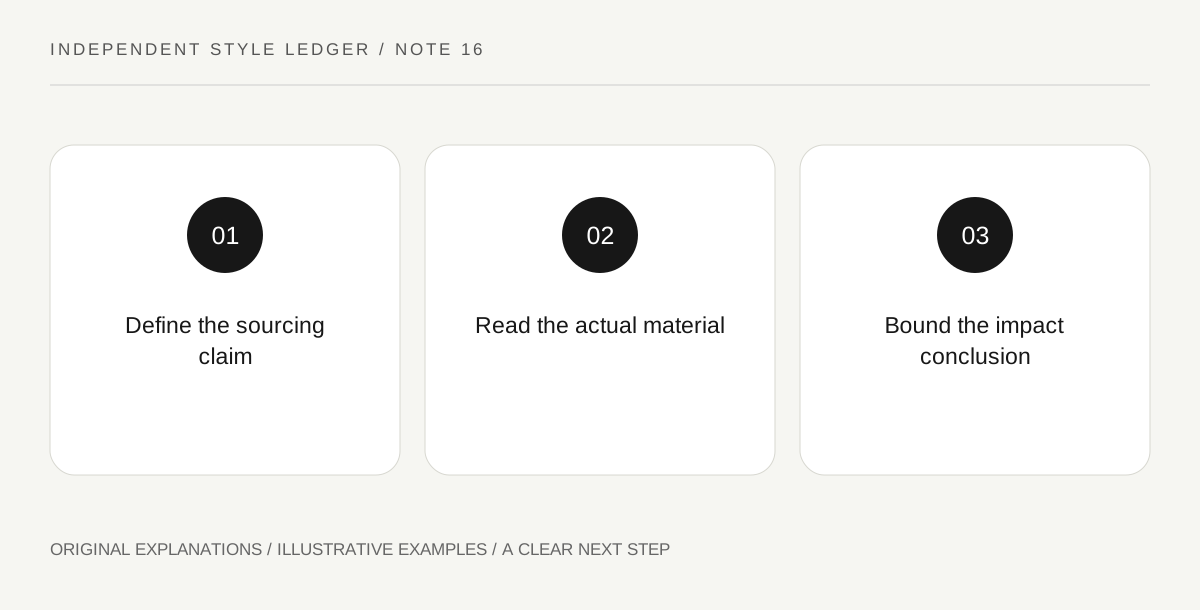
Original explanatory diagram. Read the full method and limitations below.
Ask what material is being described
Textile Exchange discusses remaining fabric and other pre-consumer material streams in its circularity guidance. A particular seller may use deadstock for a specific kind of surplus cloth. Ask what the term means in that listing and whether the claim concerns the main fabric, lining or another component. Keep that scope explicit rather than assuming the entire garment has the same sourcing history.
Keep fibre and condition questions visible
Read the stated composition, relevant care information and any disclosed variation or limitation. A previous unused fabric roll is not automatically the same thing as a previously worn garment, and the word deadstock does not identify a fibre. If the studio lacks some original supplier information, record that uncertainty. Do not replace missing evidence with an attractive story about where the material must have come from.
Read scarcity without a rushed purchase
If a maker says the fabric quantity is limited, ask what that means for size availability, replacements or future matching pieces when those questions matter. Avoid inferring a precise production count unless one is actually stated. A finite material can explain why a design may not return, but it does not establish investment value or make an unsuitable garment a good purchase. Your size and practical needs still matter.
Separate the practice from an impact conclusion
Using an existing material stream is one described practice; a claim about the whole garment’s environmental impact needs a defined method and scope. Textile Exchange’s broader framework does not certify every item sold with a deadstock label. Attribute a maker’s account and keep additional conclusions bounded. You can value the sourcing approach without inventing a percentage of impact avoided or declaring the entire purchase impact-free.
Illustrative worked example
Illustrative example: A fictional studio offers a small run made with surplus fabric and documents the outer composition but not the original mill. A reader values the use of that stock, records the missing mill information and confirms the finished care instruction. The reader does not turn the listing into a claim about exact emissions savings or future collectability. The garment must still meet the reader’s fit and spending requirements.
Questions that come up
Does deadstock mean recycled fibre?
Do not assume that. Ask what happened to the material and what the maker is claiming. Remaining fabric, recycled fibre and previously used clothing describe different possibilities that require their own documentation.
Should limited fabric make me buy a doubtful size?
No. Scarcity does not resolve fit or change your needs. Ask the maker about suitable options and accept that passing on a finite design can be preferable to buying an item you cannot comfortably use.
References and scope
These sources support the factual background. Examples and exercises are original illustrative teaching material. References do not imply endorsement.
- Textile Exchange: circularity companion — Discusses using remaining fabric as one circularity-related practice, not blanket impact certification for every deadstock garment.
- FTC: care labeling — Care instructions concern the finished covered garment; alternative methods should not be inferred from fibre alone.