A Designer Garment’s Care Instruction Belongs to the Whole Piece
A familiar fibre name can tempt you to use the routine that worked on another garment. The completed piece may include a lining, trim, dye or construction that changes the maker’s advice. Before buying an independent design or an affordable alternative, read the actual care instruction as part of the design’s everyday requirements.
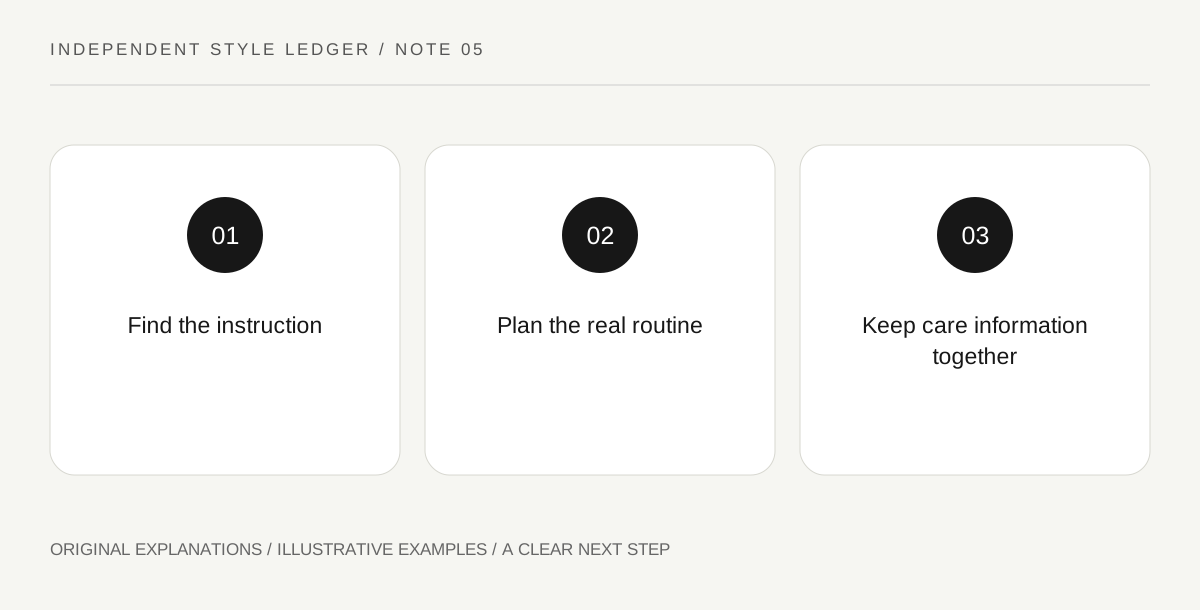
Original explanatory diagram. Read the full method and limitations below.
Find the instruction before the first wash
The FTC’s U.S. care-label guidance concerns the finished covered garment, not simply a loose fibre in isolation. Ask for the exact care wording if it is missing from an online listing. Keep that information attached to the variant you are considering. Do not substitute a care suggestion from a visually similar item or assume every garment with the same main fibre has been made and finished identically.
Translate the instruction into a practical routine
Identify the equipment, space or professional service the stated routine would require. This is a planning exercise rather than a new cleaning recipe. If the instruction uses a symbol you do not understand, consult the maker or an appropriate authoritative symbol guide before acting. Record questions about trims and removable components. An unfamiliar instruction deserves clarification rather than an improvised experiment on a newly purchased garment.
Include the routine in the alternative comparison
Two similar-looking garments can ask different things of their owner. One may fit your existing documented care routine, while another requires access to a service you rarely use. Do not invent annual cleaning costs; use an actual quote if the expense materially affects the decision. Also consider time and storage. A low purchase price is less useful if the piece remains unworn because its maintenance feels impractical.
Keep alterations and repairs in the same record
If you later change a fastening, lining or trim through an appropriate professional, keep their care advice with the garment’s original information. Ask whether the alteration affects the existing routine rather than assuming it does or does not. Store spare components and any relevant notes together. The aim is to preserve understandable information about the item through ownership, without claiming that home modifications can safely expand the maker’s original care options.
Illustrative worked example
Illustrative example: A shopper compares two fictional dark skirts with similar outlines. One page supplies a clear routine the shopper can follow, while the other lists only the main fibre. The shopper requests the second garment’s finished care instruction before deciding. If professional cleaning is required, an actual local service quote can enter the budget. The example does not recommend a cleaning method or assert that either skirt will shrink or fade.
Questions that come up
Can I follow a routine from another garment with the same fibre?
Do not assume it applies. The whole garment can include different components and finishes. Use its own instruction and ask the maker or an appropriate professional if you need clarification.
Does a restrictive care label prove poor quality?
No. It describes an ownership requirement rather than a complete quality ranking. Decide whether that routine suits you, and compare it with the specific design and functions you want from the garment.
References and scope
These sources support the factual background. Examples and exercises are original illustrative teaching material. References do not imply endorsement.
- FTC: care labeling — Care instructions concern the finished covered garment; alternative methods should not be inferred from fibre alone.