What an Inside-Seam Photograph Can and Cannot Tell a Clothing Buyer
An interior photograph can answer a useful construction question, but it is easy to turn one neat detail into a verdict about the entire garment. Read the picture in a bounded way. Identify which join and edge you are seeing, then separate visible finish from claims that would require handling or testing.
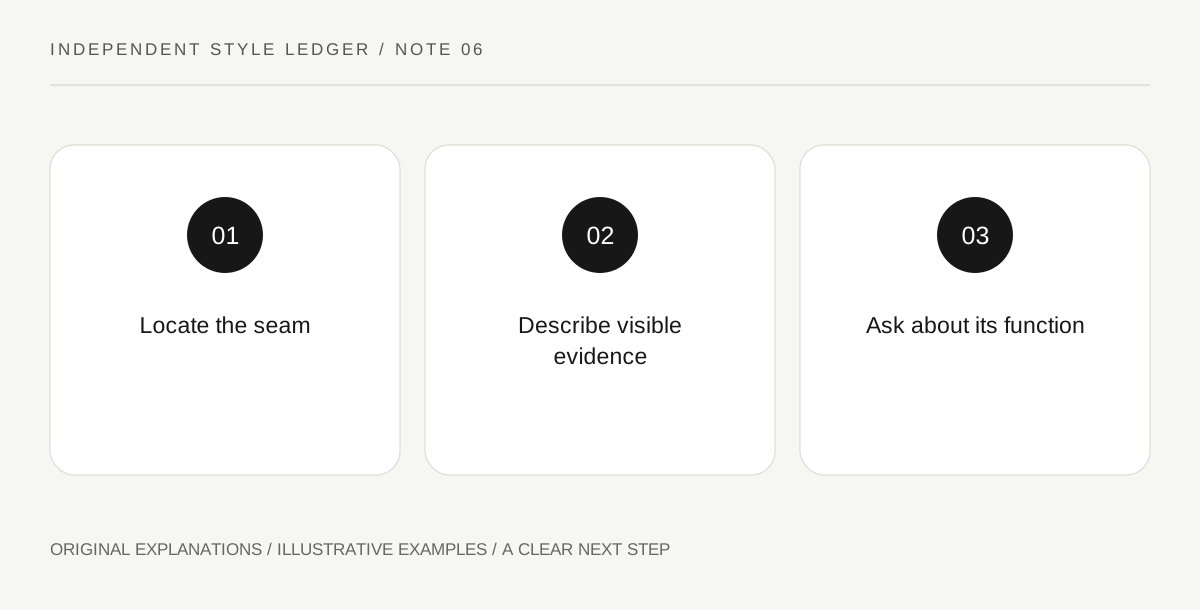
Original explanatory diagram. Read the full method and limitations below.
Name the location before the technique
Start with side seam, shoulder, hem or another identifiable location. Coats explains that seam structures and edge-finishing operations have distinct applications. A row of thread in a cropped photograph may not reveal the full arrangement of layers. If the location is unclear, ask for a wider image that shows where the detail belongs. A technical-sounding seam name is less useful than a correctly identified part of the actual garment.
Describe what is visible without completing the hidden view
You may be able to see an enclosed edge, a binding strip or an over-edge finish. Say what the image supports and leave the unseen side unresolved. Do not infer seam strength, comfort or expected years of wear from a small still photograph. Those are different questions. The image can establish that the seller is showing an interior detail without establishing a complete performance result.
Ask a construction question attached to your use
For an unlined jacket, an interior seam may be visible during ordinary handling, so its finish can be part of your aesthetic preference. For another piece, the concern may be whether a seam sits against a particular area comfortably. Ask about that location and arrangement rather than whether the whole garment is luxury quality. A specific question gives a small studio something concrete to demonstrate or explain.
Avoid turning one technique into a universal ranking
Different seam structures serve different material and design requirements. A finish you admire on one garment is not automatically the right standard for every knit, woven piece or technical item. Compare the intended function and available evidence. If an affordable alternative uses a different finish, record the difference honestly, then decide whether it affects your actual requirement instead of assuming all differences are either invisible or unacceptable.
Illustrative worked example
Illustrative example: A reader compares two fictional unlined overshirts. One listing shows a bound interior side seam; the other shows only the exterior. The reader asks the second studio for an inside view rather than declaring it poorly made. Once the view arrives, the reader can compare the visible finish as a design preference while acknowledging that neither photograph provides a durability test. The question has become specific without manufacturing a quality score.
Questions that come up
Does a neat interior prove the whole garment is durable?
No. It is one observation about one area. Material, construction, fit, use and care all remain relevant, and a picture does not replace appropriate testing or a documented performance claim.
Should every garment have the same seam finish?
No. Coats describes different structures for different applications. Learn the role of the actual join and edge before treating a favourite finish as a universal requirement for every clothing category.
References and scope
These sources support the factual background. Examples and exercises are original illustrative teaching material. References do not imply endorsement.
- Coats: seam types — Seam structures have different applications; a visible stitch line alone does not characterize all construction.