A Pocket Flap Is a Design Detail; Storage Needs Its Own Check
A visible pocket shape may be the detail that attracts you to a jacket, but it does not establish usable storage. Separate decorative outline, actual opening and capacity. This makes an independent design or lower-priced alternative easier to compare without treating every attractive flap as a place for your everyday belongings.
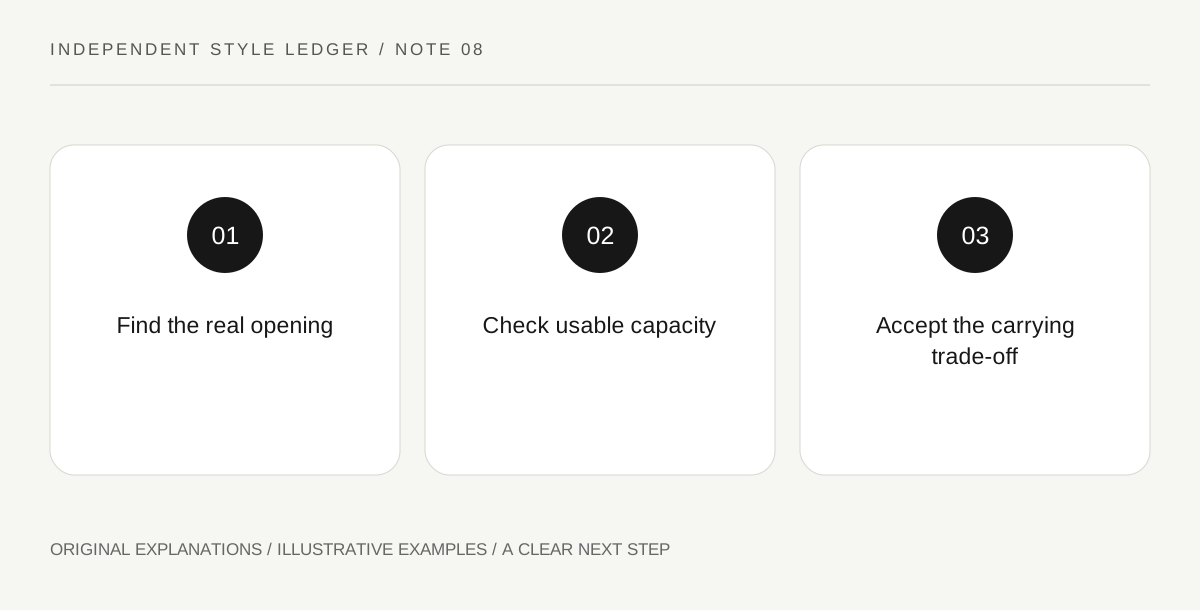
Original explanatory diagram. Read the full method and limitations below.
Identify the opening and the space behind it
Read the maker’s description for the number and location of functional pockets. A flap, welt-like line or patch outline in a photograph may not show whether the opening is usable. Ask rather than pulling at stitching on merchandise. If a pocket is temporarily secured, follow the seller’s instructions about who should open it and when. Do not assume every visible stitch across an opening is meant to be cut.
Define the item the pocket needs to hold
Choose a specific ordinary object, such as your actual card case, and note its dimensions. Ask for usable pocket dimensions or inspect them during a permitted try-on. The exterior patch size may include seam allowances or shaping, so avoid equating the visible outline with internal capacity. A pocket that looks large on a model may still be unsuitable for the item you intend to carry.
Keep appearance and carrying roles separate
An object that fits inside can still change the outline, pull on an opening or make the garment uncomfortable. During an allowed assessment, use only a clean, modest item and avoid loading or stretching merchandise. If the design is mainly decorative for your use, accept that and plan another carrying method. You do not need to disqualify a garment for failing a job its maker never claimed it would perform.
Include repair and care access in the question
If pocket function matters to daily use, ask whether the maker can advise about repair of the opening or lining should it later be needed. Do not infer repairability from visible topstitching alone. Coats’ seam guidance treats joins and component attachment as specific construction questions; the same disciplined reading helps here. A practical comparison records both the visible pocket design and the supported information about its usable function.
Illustrative worked example
Illustrative example: Lee likes a designer jacket’s large chest flap and finds a lower-priced version with a similar shape. Lee’s intended card case is wider than the second seller’s stated usable opening, even though the exterior patch looks large. Lee records the alternative as a visual option requiring separate storage, then decides whether that trade-off is acceptable. Neither fictional pocket is called defective merely because it does not serve Lee’s particular carrying plan.
Questions that come up
Can a decorative pocket still be worthwhile?
Yes, if its visual role is what you want and you have another way to carry essentials. The useful distinction is between design preference and an assumed storage promise, not a requirement that every detail perform both jobs.
Does an object fitting inside prove the pocket is suitable?
No. Consider permitted loading, comfort, the garment’s outline and any maker guidance. Do not use an oversized or heavy object to test merchandise, and keep a carrying requirement explicit before purchasing.
References and scope
These sources support the factual background. Examples and exercises are original illustrative teaching material. References do not imply endorsement.
- Coats: seam types — Seam structures have different applications; a visible stitch line alone does not characterize all construction.