Ask About Spare Buttons as a Specific Repair Resource
A distinctive button can be central to an independent garment’s character. Before paying extra for that detail, learn what happens if one is lost. A spare-button note is more useful than a vague promise that the piece is timeless, and it keeps a small repair question attached to the actual design.
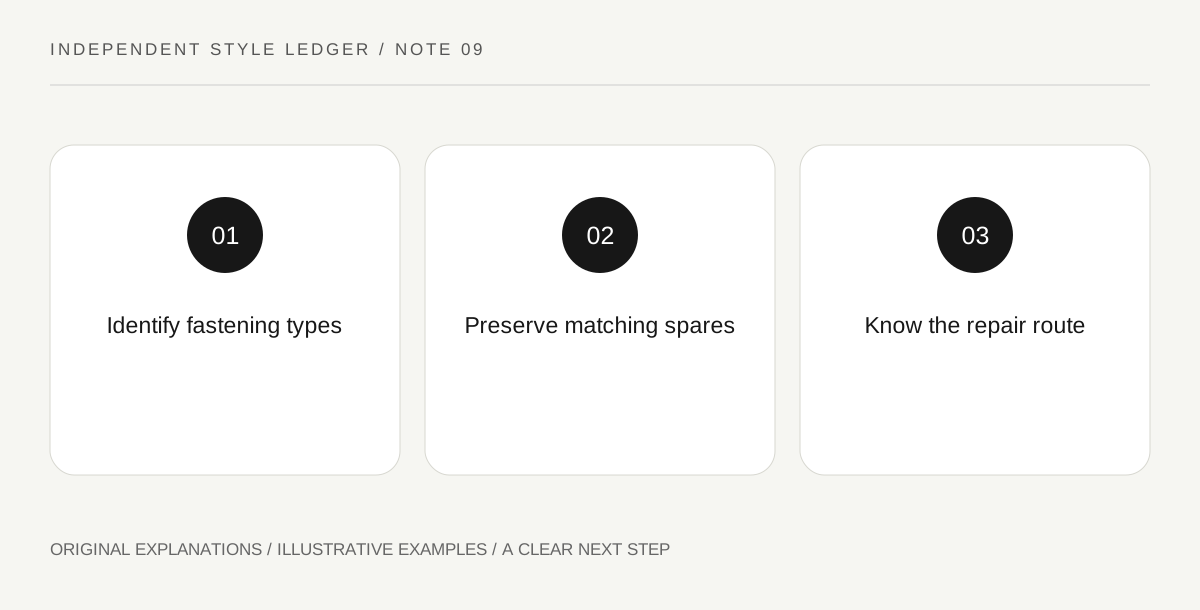
Original explanatory diagram. Read the full method and limitations below.
Identify which buttons are different
Inspect the front, cuffs, collar and any interior fastening. A garment may use more than one size or style. Ask whether supplied spares cover each relevant type, and record the answer without assuming an attached packet contains every version. If the design uses a custom fastening rather than an ordinary button, ask the maker what replacement support exists instead of searching for a visually similar part immediately.
Keep the spare with the garment’s identity
Store any supplied spare securely with the product name and care information, away from children and pets. A loose button in a general household tin can become difficult to match later. Keep a simple record of its diameter or location only where useful, and do not remove buttons from a new garment for comparison. The aim is to preserve a repair resource, not to perform an unnecessary modification.
Separate matching from installation
A replacement’s appearance is only part of the repair question. Its size, attachment style and compatibility with the garment need appropriate assessment. Ask a qualified repairer or the maker about the actual item rather than improvising a larger button to compensate for an unrelated fit problem. This article does not provide a universal sewing method. The right next step may be a straightforward professional repair rather than a new accessory kit.
Read handmade detail claims at the operation level
If a button is described as handmade, ask what part of its production that refers to and whether future replacements would necessarily look identical. V&A embroidery resources illustrate the breadth of named craft techniques; a craft word deserves a specific process explanation. Variation can be an intended feature, but it should not become a blanket excuse for an unexplained mismatch. Keep the maker’s description distinct from your own inspection.
Illustrative worked example
Illustrative example: A reader considers a fictional shirt with large front buttons and smaller cuff buttons. The studio confirms that one spare of each type is supplied and explains its replacement-contact route. The reader stores them with a note naming the shirt instead of adding both to a mixed tin. Years of durability are not predicted; the practical benefit is that an identified matching resource will be available if a suitable repair is later needed.
Questions that come up
Does no spare button prove poor construction?
No. It identifies a repair-planning question, not a complete quality verdict. Ask about replacement availability and decide how much that matters for a garment whose distinctive fastening is part of its appeal.
Should I buy a large repair kit immediately?
Start with the actual repair need and your skills. A supplied spare and a professional repair route may be sufficient. Do not buy unfamiliar tools simply to make the ownership plan appear complete.
References and scope
These sources support the factual background. Examples and exercises are original illustrative teaching material. References do not imply endorsement.
- V&A: embroidery collection — Embroidery encompasses distinct techniques and contexts; the word does not establish an entire garment production method.