Repeat Print or Placed Motif: Ask Which Part of the Photograph Is Guaranteed
A dramatic flower at a neckline may be the reason you save a garment photograph. Before choosing a less expensive printed alternative, ask whether that exact placement is part of the design or one result of cutting a repeating fabric. The answer changes what you should expect from the piece delivered.
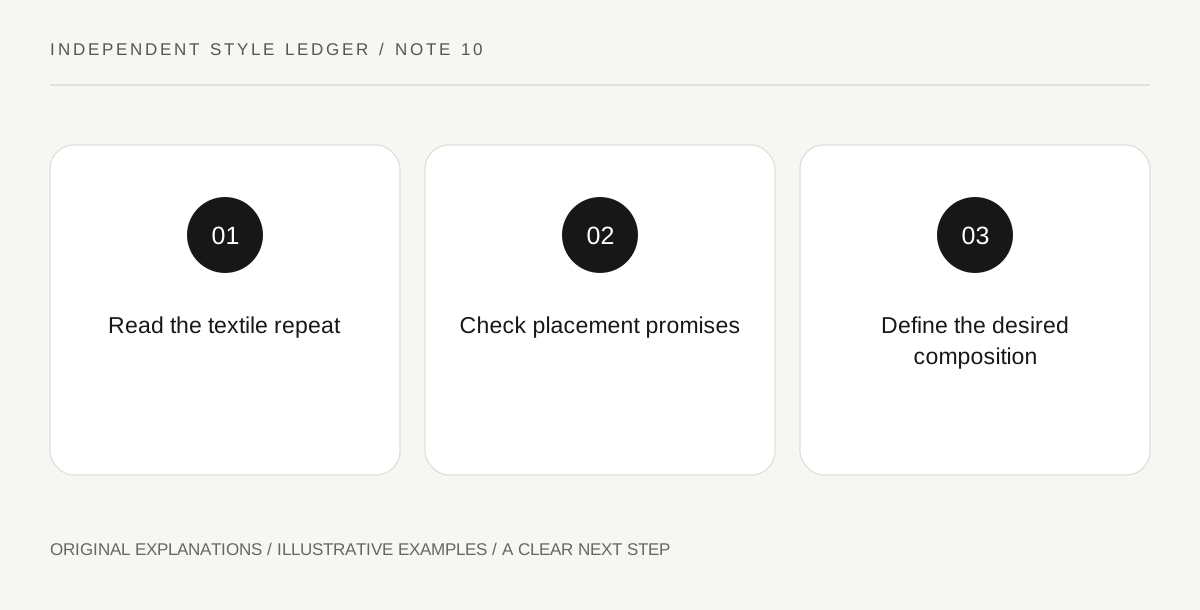
Original explanatory diagram. Read the full method and limitations below.
Distinguish the fabric pattern from the garment layout
A textile can carry repeating motifs while the garment’s pattern pieces determine where those motifs appear after cutting. V&A writing on William Morris textiles discusses repeat designs as textile compositions. Use that distinction to ask whether the product guarantees a particular placement, rather than assuming every garment made from the same cloth will reproduce the photographed arrangement at every seam and edge.
Look at more than the central front image
Compare available views of the back, sleeves and side seams, keeping track of which images show the same sample. A flat fabric swatch explains the print but may not explain the finished layout. If a product note says placement varies, read what that means for your preferred feature. Ask for clarification if a specific motif location is essential, while recognizing that a studio may not offer individual selection.
Describe the feature you want to preserve
Perhaps you like a broad border, a quiet central area or a motif positioned away from a fastening. Write that requirement in ordinary language. An alternative with the same colour family may not preserve the compositional effect. Conversely, a different pattern could satisfy the same preference for generous spacing or a strong lower border. This creates room for an honest alternative without pretending two prints are identical.
Avoid turning every mismatch into a defect claim
A repeated pattern may not be continuously matched across every construction join. Read the product’s stated design and inspect the actual piece under the seller’s conditions. If the delivered layout differs from a specific promise, document that promise and seek an appropriate resolution. If the variation was clearly described, assess whether it suits you rather than treating the sample photograph as an unspoken guarantee of every motif’s position.
Illustrative worked example
Illustrative example: Erin likes a fictional dress because a large leaf sits near one shoulder in the sample image. The description says placement varies by garment. Erin asks whether that shoulder arrangement can be selected; the answer is no. Erin either accepts a variable repeat or searches for a design with an explicitly placed motif. The exercise does not claim one printing method is more authentic, more durable or inherently worth a higher price.
Questions that come up
Does the swatch prove where a motif will sit?
No. It shows the fabric design rather than necessarily the finished garment layout. Use the product’s placement description and relevant garment views when a particular position is important to your decision.
Must an affordable alternative copy the same print?
No. It can satisfy a defined preference such as a border, generous spacing or a quiet neckline using a different original design. Explain the shared feature and accept the differences rather than claiming a replica.
References and scope
These sources support the factual background. Examples and exercises are original illustrative teaching material. References do not imply endorsement.
- V&A: William Morris textiles — Historical textile repeats and printing processes; no current product availability or replica endorsement.