Before Buying for Alteration, Ask Which Design Lines Would Move
An appealing garment in an imperfect size can seem like a bargain if you assume a later alteration will solve everything. Ask an appropriate professional to assess the actual piece first. The useful question is not simply whether it can be made smaller, but how the proposed change would affect its design and function.
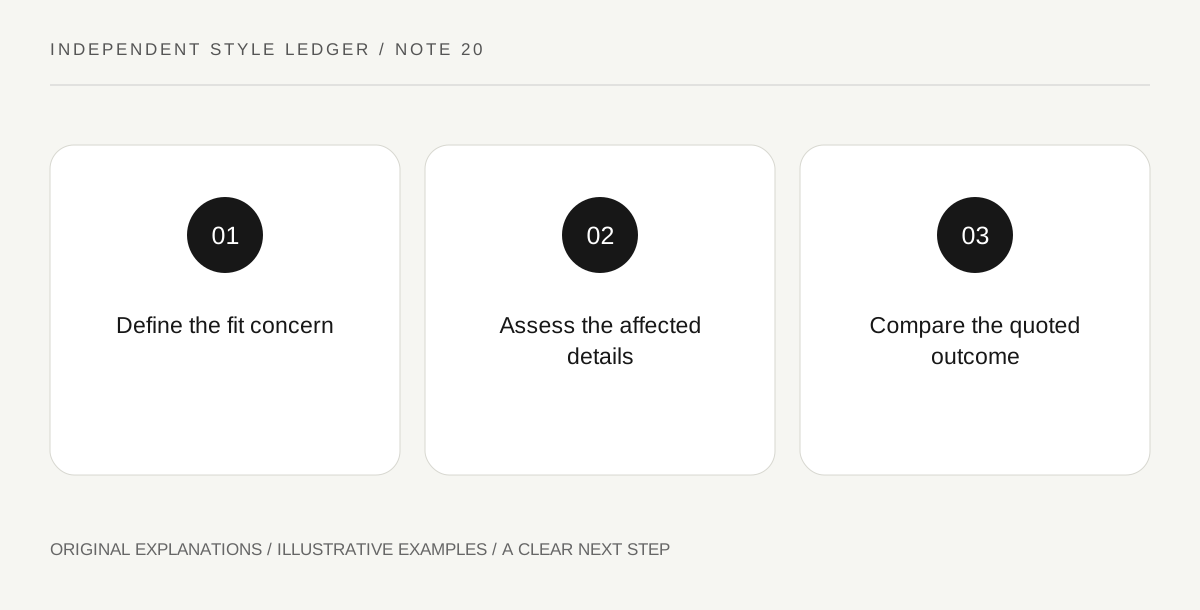
Original explanatory diagram. Read the full method and limitations below.
Describe the specific fit concern
Name the area and ordinary movement involved rather than asking for a complete transformation from a photograph. A professional may need to examine the garment and see it on the wearer under appropriate fitting conditions. Do not promise yourself a result before that assessment. Keep any seller return conditions in mind and avoid modifying the item while you are still deciding whether to keep it.
Trace the details near the proposed change
Look at pockets, seams, vents, fastenings, lining and decorative placement around the area. Ask which of those would move, need reconstruction or limit the change. V&A investigations of hidden garment structure illustrate why the exterior does not tell the whole construction story. A seemingly simple silhouette may contain layers you cannot assess from the listing, so avoid assigning an easy alteration label from an image alone.
Request an outcome and a quote together
Ask what result is realistically achievable, what would remain different and what the service would cost and require in time. A price without a defined operation is not enough for a comparison. If the professional cannot establish the result until opening part of the garment, ask how that uncertainty will be handled. Do not invent a universal percentage of the purchase price as an alteration allowance.
Compare with the design you actually want
Add the confirmed service quote to the purchase plan, then assess whether the resulting garment would preserve the feature that attracted you. A different size or cut may be more appropriate. If the intended change would remove an essential detail, accept that the bargain may not serve the original brief. Keep any later care advice with the garment’s instructions once an agreed alteration is completed.
Illustrative worked example
Illustrative example: A fictional skirt is discounted, but its waist feels wrong during a permitted fitting. A repair professional explains that the proposed change would also affect a nearby pocket and requires a more involved operation than the buyer expected. The buyer compares the actual quote and described outcome with another suitable cut. No alteration is performed in this example, and no universal judgment is made about the feasibility of changing skirts.
Questions that come up
Can every garment be altered into the shape I want?
No such assumption is justified. Materials, construction, available allowances and detail placement constrain possibilities. Ask a qualified professional about the actual piece before buying on the promise of a transformation.
Should I estimate alteration cost from the purchase price?
Use an actual assessment and quote for the proposed operation. The retail price does not establish the labour, construction access or outcome of a particular alteration, and a cheap garment can still require substantial work.
References and scope
These sources support the factual background. Examples and exercises are original illustrative teaching material. References do not imply endorsement.
- V&A: X-raying fashion — Museum examination reveals hidden garment construction; normal retail pictures cannot substitute for that investigation.
- FTC: care labeling — Care instructions concern the finished covered garment; alternative methods should not be inferred from fibre alone.